The books we study from were born in these classrooms: from research in applied linguistics and from teaching in Assisi, from mistakes, ours and our students', and from questions that have kept coming back for more than thirty years. Our current course, In italiano. Il corso, is published by Hoepli.
Start from the situation
You learn a language by using it: introducing yourself, asking, telling, discussing. Grammar, too, grows out of use, within a given context. That is why our approach is communicative and situational: you start from a concrete situation and learn to handle it in Italian.
Few structures, many sentences
Grammar follows a principle of generativity: a few structures, presented in their natural order, from which many others follow.
First the words you use
Vocabulary is chosen by frequency of use, so you learn first what you will actually use.
Pronunciation has its own space
Dedicated exercises on the sounds that are hardest to hear and to produce, with pronunciation lessons every week.
Contrastive grammars
Lessons are taught in Italian. For individual study, contrastive grammars are available in fifteen languages, from English to Chinese, from Russian to Arabic, comparing the structures of Italian with those of your mother tongue.
Texts for specific needs
Alongside the course there are texts for specific needs: 19th- and 20th-century literature, graded tests for certification, and Italiano in chiesa for seminarians and religious.
The authors of the method, Angelo and Gaia Chiuchiù, direct the courses: they design the programmes and follow the work in class. Studying here means studying with the people who wrote the books and who test them every day in the classroom.
The books of the method
Research
Research in applied linguistics is where the method comes from, and it keeps testing it. Selected publications by Gaia Chiuchiù on Italian and second language acquisition.
-
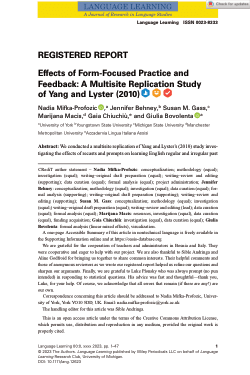
Mifka-Profozic, N., Behney, J., Gass, S. M., Macis, M., Chiuchiù, G., & Bovolenta, G. (2023). Effects of form-focused practice and feedback: A multisite replication study of Yang and Lyster (2010). Language Learning, 73(4), 1164–1210. https://doi.org/10.1111/lang.12623 · PDF (open access)
Conducted in Italy and Bosnia with secondary school learners, as part of the Language Learning SLA-for-All Reproducibility Project.
-
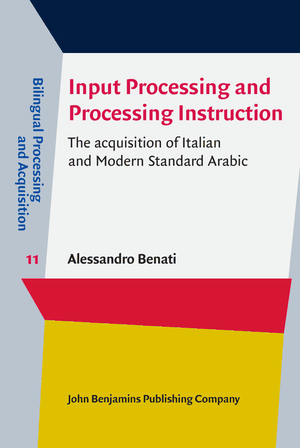
Benati, A. G., & Chiuchiù, G. (2021). Structured input vs. textual enhancement on the acquisition of Italian subjunctive of doubt: Sentence and discourse-level tasks. In A. G. Benati, Input processing and processing instruction: The acquisition of Italian and Modern Standard Arabic (pp. 47–66). John Benjamins. https://benjamins.com/catalog/bpa.11
-
Chiuchiù, G., & Benati, A. (2020). A self-paced-reading study on the effects of structured input and textual enhancement on the acquisition of the Italian subjunctive of doubt. Instructed Second Language Acquisition, 4(2), 235–257. https://doi.org/10.1558/isla.40659
Teacher training courses
- 15–16 June 2017 Summer course in Second Language Acquisition Led by Susan Gass. Accademia Lingua Italiana Assisi, Assisi (Perugia).
- 28–30 August 2018 Summer course in Second Language Acquisition Led by Susan Gass. Accademia Lingua Italiana Assisi, Assisi (Perugia).
- 10–12 January 2019 Focus on Form in second language teaching Led by Alessandro Benati. Accademia Lingua Italiana Assisi, Assisi (Perugia).
- 29 May – 1 June 2019 Communication and tasks in second language teaching Led by Alessandro Benati. Accademia Lingua Italiana Assisi, Assisi (Perugia).